Top Digital Marketing Tactics for Real Estate Agencies in 2026
The real estate agencies is experiencing one of the most significant digital marketing shifts in its history. Buyer behavior has changed. Search algorithms have evolved. Social platforms have restructured how content is distributed. And AI has fundamentally altered what’s possible and what’s expected from a marketing strategy.
The agencies generating consistent, predictable growth in 2026 are not doing more of the same things louder. They’ve adapted their playbook to match a market that rewards precision, authenticity, and technical sophistication over volume and guesswork.
Here’s what that playbook looks like.
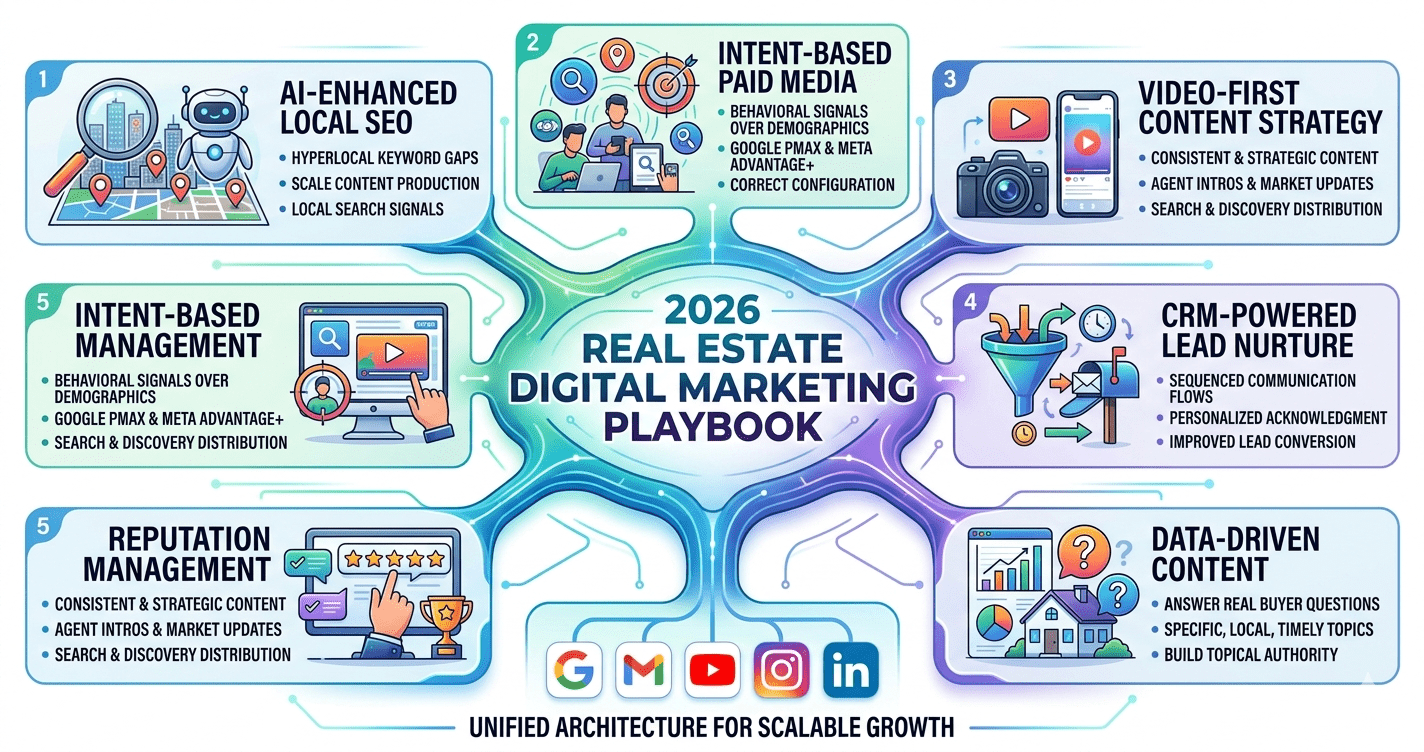
1. AI-Enhanced Local SEO
Local SEO has always been the most high-intent channel for real estate agencies. When someone searches “townhomes for sale in [neighborhood]” or “top real estate agent in [city],” they are signaling active buying intent. Capturing that search traffic remains one of the best lead generation investments an agency can make.
What’s changed in 2026 is how that SEO is executed. AI tools now allow agencies to identify hyperlocal keyword gaps at scale opportunities that a manual research process would take months to surface. They also support content production at a pace that keeps agency websites updated and authoritative across dozens of neighborhood-level topics simultaneously.
This is an area where partnering with a seasoned property marketing agency makes a material difference. Building and maintaining the technical and content infrastructure required to rank competitively in multiple local markets is not a part-time effort.
2. Intent-Based Paid Media Campaigns
The shift from broad demographic targeting to intent-based paid media has been transformative for real estate advertisers. Rather than targeting buyers by age and income bracket alone, the most effective campaigns in 2026 layer in behavioral signals recent property search activity, mortgage research behavior, life event triggers like marriage or relocation to reach people who are actively in a decision-making window.
Google’s Performance Max campaigns and Meta’s Advantage+ suite both offer sophisticated intent-targeting options that, when configured correctly by experienced practitioners, consistently outperform traditional awareness-based real estate advertising on cost-per-lead metrics.
The key word is “correctly.” Poorly structured campaigns with broad targeting and generic creative still dominate real estate ad spend which is precisely why agencies that invest in structured real estate digital marketing execution have a significant and measurable advantage.
3. Video-First Content Strategy
Static property photography remains important, but it no longer captures or holds attention the way it did five years ago. In 2026, video is the primary medium through which buyers evaluate properties, form impressions of agents, and decide whether to reach out.
Agencies winning on video aren’t necessarily producing the highest-budget content. They’re producing the most consistent and strategically structured content market update videos that demonstrate expertise, neighborhood guide reels that build local authority, agent introduction videos that humanize the team, and short-form property highlights optimized for Instagram Reels and YouTube Shorts.
The distribution strategy matters as much as the production quality. A well-structured video distributed across YouTube (for search), Instagram (for discovery), and LinkedIn (for professional credibility) generates awareness across multiple buyer and seller segments simultaneously.
4. CRM-Powered Lead Nurture
Most real estate agencies lose enormous value at the same stage of the funnel: lead capture. Prospective clients submit an inquiry, receive a generic auto-response, and then hear nothing for days or never. By the time an agent follows up, the lead has moved on to a competitor who responded first.
CRM-powered nurture sequences solve this problem systematically. When a lead submits an inquiry, they immediately enter a sequenced communication flow a personalized acknowledgment, followed by relevant content matched to their inquiry type, followed by a soft-touch follow-up from a specific agent. This sequence can run automatically, ensuring no lead falls through the cracks regardless of how busy the team is.
Agencies that implement this infrastructure typically report significant improvements in lead-to-consultation conversion rates without any increase in ad spend. It’s one of the highest-ROI improvements available to most agencies today, and resources like truerealtyvalue.com provide useful benchmarks for understanding what strong lead conversion performance looks like in current market conditions.
5. Reputation Management as a Growth Strategy
Online reviews are not a passive byproduct of good service they’re an active marketing asset that requires deliberate management. Agencies with strong Google review profiles rank higher in local search, convert more website visitors into inquiries, and generate more referrals from clients who discovered them online.
In 2026, the best agencies have systematized their review generation process. Post-transaction, clients receive a structured outreach sequence that makes leaving a review simple and feel natural. Review responses are crafted and posted promptly. Negative reviews are addressed professionally and visibly. The result is a continuously growing social proof asset that compounds in marketing value over time.
6. Data-Driven Content That Answers Real Buyer Questions
Generic real estate blog content “tips for first-time buyers” and “how to stage your home” generates almost no organic search value anymore. The market is saturated with that content, and search engines have become sophisticated enough to reward depth, specificity, and genuine expertise over keyword density.
The agencies building real search authority in 2026 publish content that answers specific, local, and timely questions: “What is the average days-on-market for condos in [neighborhood] right now?” or “How do rising mortgage rates affect buying power in [city] in 2026?” This type of data-informed content earns backlinks, builds topical authority, and positions the agency as a genuine market expert rather than a content factory.
Pulling It All Together
The difference between an agency running a collection of marketing tactics and one running a coordinated marketing system is the difference between unpredictable lead flow and scalable growth. Individual channels have their own logic and their own metrics. A strategic agency partner ties them together into a unified architecture where each channel reinforces the others SEO drives organic volume, paid media captures high-intent traffic, video builds trust, CRM converts and retains, and reputation compounds authority over time.
That’s what Centric builds for real estate agencies. Our digital marketing services and real estate industry expertise are designed to deliver not just better individual campaign results, but a marketing infrastructure that gets stronger and more efficient the longer it runs.