How Automation Testing Courses Prepare Learners for Codeless Testing Tools
The testing landscape has shifted dramatically over the past few years. What once required extensive programming knowledge now welcomes professionals from diverse backgrounds, thanks to codeless testing platforms. Automation Testing Courses have evolved to reflect this change, incorporating modules that teach learners how to work with tools requiring minimal or no coding expertise. This shift opens doors for manual testers, business analysts, and domain experts who understand application behaviour but lack traditional development skills.
What Makes Codeless Testing Different
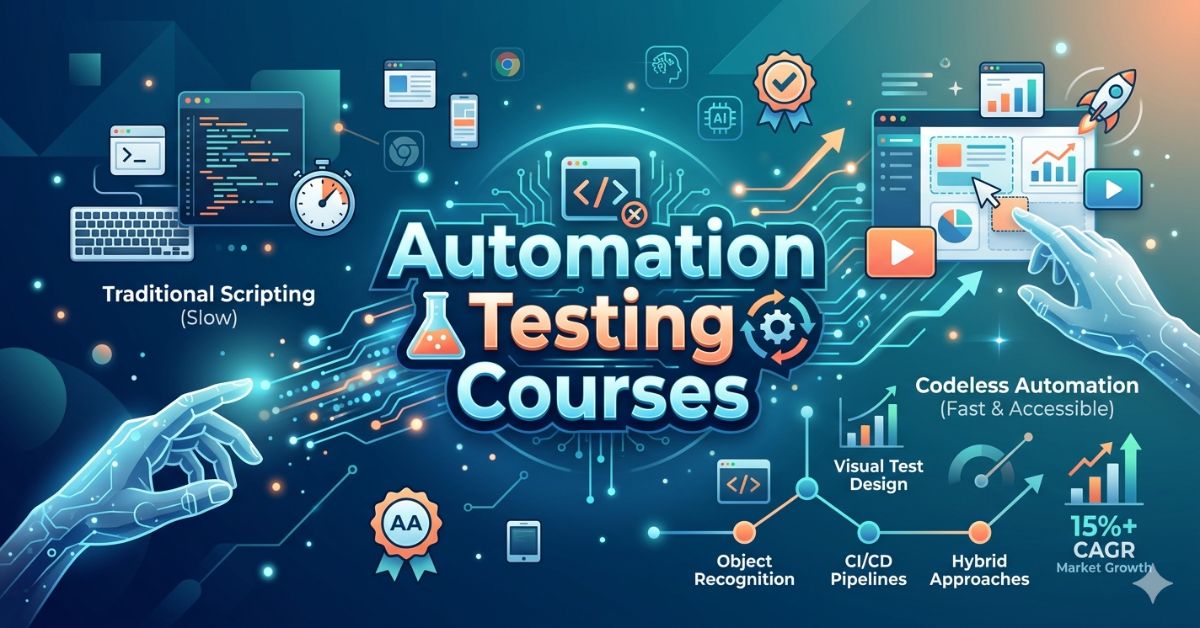
Traditional automation demanded proficiency in languages like Java, Python, or JavaScript. Testers spent weeks learning syntax before writing their first script. Codeless tools change this equation entirely. Platforms such as Katalon Studio, Testim, and Leapwork allow users to create test cases through visual interfaces, drag-and-drop actions, and record-and-playback features.
This does not mean coding becomes irrelevant. Rather, the barrier to entry lowers significantly. Professionals can start automating within days instead of months, while still having the option to add custom scripts when complex scenarios arise.
Market Growth Driving Curriculum Changes
The codeless testing segment has witnessed remarkable expansion. According to industry projections, the global codeless testing market is expected to grow at a compound annual growth rate exceeding 15% through 2030. Organisations favour these tools because they reduce dependency on specialised developers and accelerate release cycles.
Indian enterprises have embraced this trend enthusiastically. With the country’s software testing services market valued at over $9 billion and growing steadily, companies seek professionals who can operate across both traditional and modern testing approaches. This dual capability makes candidates significantly more employable.
How Training Programmes Address This Shift
Modern curricula now dedicate substantial portions to codeless platforms. Learners typically encounter:
| Module | Skills Covered |
| Visual Test Design | Creating tests using interface-based builders |
| Object Recognition | Understanding how tools identify UI elements |
| Data-Driven Testing | Parameterising tests without writing loops |
| Integration Setup | Connecting codeless tools with CI/CD pipelines |
| Hybrid Approaches | Combining codeless features with custom scripts |
Professionals enrolling in Automation Testing Courses in Bangalore often find these modules particularly valuable. The city’s thriving tech ecosystem, home to over 4,000 technology companies, demands testers who can adapt quickly to varied toolsets across different client projects.
Practical Skills That Transfer Across Tools
One advantage of structured learning is the emphasis on transferable concepts. While specific tools may differ, the underlying principles remain consistent:
- Test Design Thinking: Understanding what to test matters more than how to test it. Courses teach learners to identify critical user journeys, boundary conditions, and integration points before touching any tool.
- Element Identification Strategies: Whether using XPath, CSS selectors, or AI-powered locators, the logic behind finding elements stays similar. This knowledge applies equally to Selenium, Playwright, or any codeless alternative.
- Maintenance Best Practices: Codeless tests can become unmaintainable if poorly organised. Training programmes stress modular design, reusable components, and clear naming conventions that prevent technical debt accumulation.
Career Opportunities and Compensation
The Indian job market reflects growing demand for professionals skilled in modern testing approaches. According to Glassdoor data from 2026, automation testers in India earn between ₹5,00,000 and ₹15,00,000 annually, depending on experience and location. Those proficient in multiple tools, including codeless platforms, often command salaries at the higher end of this range.
Bangalore offers particularly strong opportunities, with average salaries approximately 15-20% above the national median. Companies ranging from multinational corporations to funded startups actively recruit testers comfortable with evolving toolsets.
| Experience Level | Annual Salary Range |
| Fresher | ₹3,50,000 – ₹5,50,000 |
| Mid-Level (3-5 years) | ₹7,00,000 – ₹12,00,000 |
| Senior (5+ years) | ₹12,00,000 – ₹18,00,000 |
Bottom Line
Codeless testing represents evolution rather than revolution. The fundamentals of quality assurance remain unchanged—understanding requirements, designing meaningful tests, and ensuring software behaves as expected. What changes is accessibility. Professionals who previously felt excluded from automation now have pathways to contribute meaningfully.
Structured training bridges the gap between theoretical knowledge and practical application. By exposing learners to both traditional scripting and modern codeless approaches, these programmes create versatile testers ready for whatever tools their future employers adopt. In a market that values adaptability above narrow specialisation, this breadth of preparation proves invaluable.