
Dallas Cost of Living: What I Actually Spend After Moving Here From a Coastal City
When I first started researching Dallas cost of living before my move, every source seemed to disagree with the next. One site claimed rent averaged around $1,300, another said closer to $2,000, and a third landed somewhere in between. After actually living here for over a year now, tracking my own budget month to month, I finally understand why the numbers spread out so much, and I want to walk through what the real experience of Dallas cost of living looks like once you get past the conflicting headline stats.
The Problem: Cost of Living Numbers for Dallas Rarely Agree With Each Other
If you’ve tried researching Dallas cost of living yourself, you’ve probably noticed the same frustration. Depending on which source you check, you’ll see wildly different figures for the exact same city:
- Rent estimates ranging anywhere from roughly $1,300 to nearly $2,000 for similar unit types
- “Comfortable salary” recommendations that swing by tens of thousands of dollars depending on the source
- Cost of living index comparisons that call Dallas both cheaper and more expensive than the national average, sometimes on the same page
- Utility and grocery estimates that don’t account for how much these shift seasonally, especially with Texas summers
None of these sources are necessarily wrong. They’re usually measuring different neighborhoods, different household sizes, or different time periods, which is exactly why relying on a single number for Dallas cost of living can leave you badly unprepared.
My Experience Actually Living Within a Dallas Budget
Before moving, I built my budget around one of the higher published estimates for Dallas cost of living, assuming it was safer to overestimate. What I found instead was that my actual monthly spending landed somewhere in the middle of most published ranges, closer to what several sources describe as a moderate lifestyle, once I accounted for a specific neighborhood choice and the fact that I don’t drive as much as the “average” resident these estimates are built around.
The biggest adjustment for me wasn’t the overall Dallas cost of living number itself, it was realizing how much a single decision, like which part of the city I chose to live in, changed my personal total far more than any citywide average could predict.
Breaking Down Dallas Cost of Living by Category (Solution + Tips)
1. Housing: The Category That Varies Most
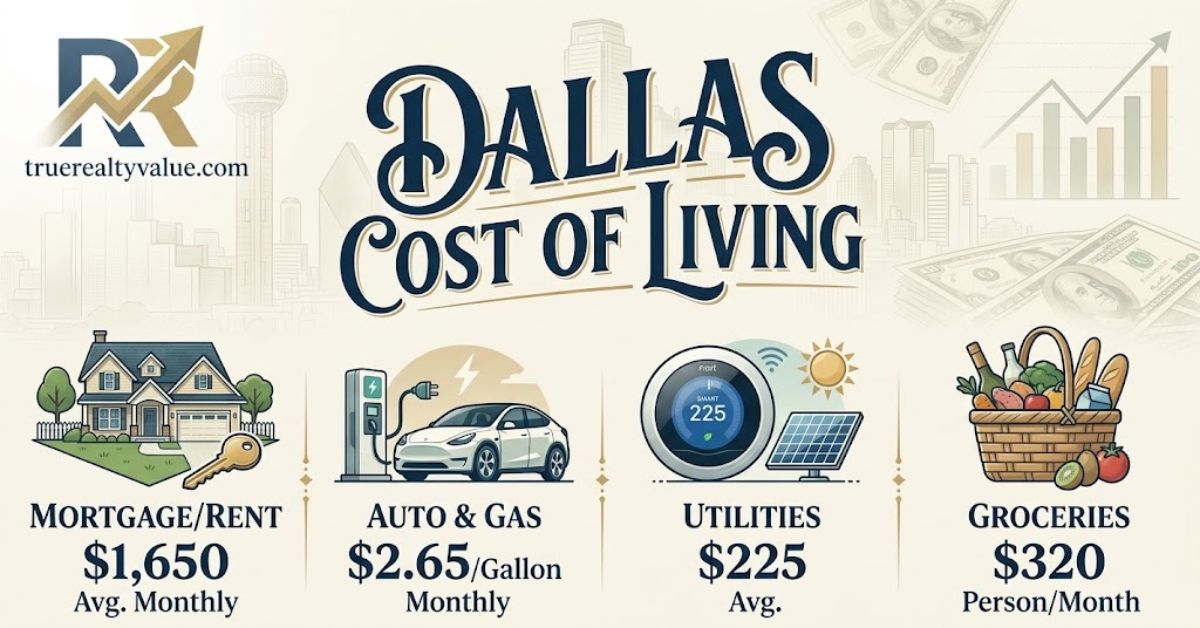
Housing is consistently described as the single biggest driver of Dallas cost of living, and it’s also the category with the widest spread between sources. Recent median rent figures for Dallas have been reported anywhere from roughly $1,300 to nearly $2,000 depending on the data source and timeframe, with apartment rents in central areas like Uptown or Deep Ellum running noticeably higher than suburban options in Plano or Frisco.
Tip: Don’t anchor your budget to a single citywide rent average. Pull listings for your actual target neighborhood, since the gap between two Dallas neighborhoods can be larger than the gap between Dallas and an entirely different city.
2. Utilities and Seasonal Swings
One detail that surprised me after moving is how much utility costs shift with the seasons here. Average monthly electricity bills have been estimated in the range of $110 to $200 for most of the year, but that figure can climb significantly higher during peak summer months when air conditioning runs constantly.
Tip: When budgeting for Dallas cost of living, build in a summer buffer for your electricity bill specifically. Averaging your utility cost across the year will underestimate what you actually pay in July and August.
3. Groceries and Everyday Expenses
Grocery costs in Dallas tend to track close to, or slightly below, the national average, with estimates for a single person’s monthly groceries generally falling somewhere between $250 and $390 depending on shopping habits and household size.
Tip: This category is one of the more predictable parts of Dallas cost of living, so it’s a reasonable place to trust the published averages rather than assuming your specific situation will be drastically different.
4. Transportation and Car Ownership
Unlike housing or utilities, transportation in Dallas comes with a structural reality most estimates mention directly: car ownership is close to essential for most residents, since public transit coverage through DART is limited outside core areas. Car insurance in Texas has been estimated around $1,400 annually on average, on top of gas, maintenance, and financing costs.
Tip: If you’re trying to minimize your Dallas cost of living, choosing a neighborhood with genuine walkability or reliable DART access can meaningfully reduce this category, but confirm actual commute routes before assuming a location is “transit friendly.”
5. What Income Actually Feels Comfortable
Estimates for a comfortable single person income in Dallas have ranged from around $62,000 up to $75,000 annually, with couples generally needing significantly more and families needing considerably higher household income. Texas having no state income tax is frequently cited as a meaningful offset that makes take-home pay stretch further than the same salary would in many other states.
Tip: Use these income ranges as a starting point, not a guarantee. Your actual comfort level depends heavily on which neighborhood you choose and how much of your spending goes toward optional categories like dining and entertainment.
Real Example: How Neighborhood Choice Changed My Total Monthly Number
A coworker who relocated to Dallas around the same time I did chose a downtown adjacent neighborhood, prioritizing walkability and nightlife access. I chose a suburb further out specifically to keep housing costs lower. Even though we started with similar salaries, our actual Dallas cost of living ended up differing by several hundred dollars a month, almost entirely due to housing and how often each of us relied on a car versus walking or transit.
Neither choice was wrong. His version of Dallas cost of living traded higher rent for lower transportation costs and more walkable convenience, while mine traded a longer commute for meaningfully cheaper housing. The lesson wasn’t which neighborhood is objectively better, it was that any single published number for Dallas cost of living is really an average of choices like these, not a fixed reality everyone experiences the same way.
FAQs
Q1. Is Dallas cost of living higher or lower than the national average?
It depends on the source and category. Several estimates place overall Dallas cost of living close to or slightly above the national average, while housing specifically is frequently reported as cheaper than the national average, even as other categories like utilities run higher.
Q2. How much does rent typically cost in Dallas?
Recent estimates vary widely, generally ranging from around $1,300 to nearly $2,000 for a typical unit, depending heavily on the specific neighborhood, unit size, and which data source is used.
Q3. What salary do you need to live comfortably in Dallas?
Estimates for a single person generally fall between $62,000 and $75,000 annually, though this can shift significantly based on your chosen neighborhood and lifestyle preferences.
Q4. Why do Dallas cost of living estimates vary so much between websites?
Different sources use different methodologies, timeframes, and neighborhood assumptions, which is why one estimate might describe Dallas as affordable while another describes it as expensive, even when both are technically accurate for their specific data set.
Q5. Do you need a car to live in Dallas?
For most residents, yes. Public transit through DART exists but has limited coverage outside core areas, making car ownership close to essential for most neighborhoods and lifestyles.
Conclusion
Dallas cost of living isn’t one fixed number, it’s a range shaped heavily by which neighborhood you choose, whether you rely on a car or public transit, and how the seasons affect your utility bills. The conflicting statistics you’ll find online aren’t necessarily inaccurate, they’re usually just measuring different slices of the same city.