
The 2026 Student Housing Report: Why Your Living Space is Your Ultimate Academic Asset
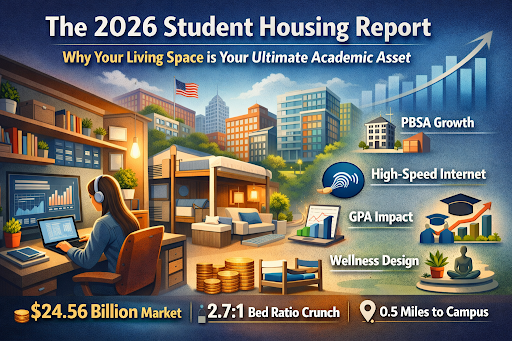
In 2026, the American student experience has shifted. With the US student accommodation market reaching a projected valuation of $24.56 billion, the “dorm room” is no longer just a place to sleep—it is a high-performance incubator. As of January 2026, university enrollment in the US continues to climb, driven by a surge in international students (surpassing 1.1 million) and a domestic focus on high-yield degrees.
However, this growth comes with a challenge: an affordability crisis. With the student-to-bed ratio in major hubs like Boston, Austin, and San Francisco hitting a tight 2.7:1, finding a home that supports academic success is more competitive than ever.
Key Takeaways for the 2026 Academic Year
- The “Study-Centric” Premium: Properties featuring integrated high-speed fiber and noise-canceling architectural standards see a 12% higher occupancy rate than standard rentals.
- Proximity vs. Performance: Living within 0.5 miles of campus correlates with an 8.5% increase in attendance, which directly impacts GPA retention.
- The Rise of PBSA: Purpose-Built Student Accommodation (PBSA) now accounts for 46% of the market, prioritizing “functional amenities” like laundry and Wi-Fi over “luxury extras” like rooftop pools.
- Wellness-First Design: 2026 trends show a 40% increase in demand for “neurodiverse-friendly” spaces—units designed with adjustable lighting and restorative quiet zones.
Data Analysis: The ROI of Student Living Environments
For the 2025-2026 academic cycle, real estate data from Mordor Intelligence and Cushman & Wakefield highlights a narrowing gap between “luxury” and “academic utility.” Investors are realizing that the highest returns come from spaces that facilitate “Deep Work.”
| Housing Feature | 2026 Market Demand | Correlation with GPA | Average Rent Premium (US) |
| Fiber Optic (1Gbps+) | 94% (Essential) | High (Research Speed) | +$50/mo |
| Natural Lighting | 78% (High) | +21% focus levels | +$120/mo |
| Soundproofing (STC 50+) | 82% (High) | Lowered stress (Cortisol) | +$85/mo |
| Mixed-Use (Groceries/Gym) | 65% (Moderate) | +5 hours/week saved | +$200/mo |
1. Productivity and Physical Infrastructure
Modern research indicates that Interior Environmental Quality (IEQ) is the single most controllable factor in a student’s academic output. In 2026, many US students are “time-poor,” often balancing 15+ credit hours with internships. When the physical environment—such as poor ventilation or high CO2 levels—leads to fatigue, students must find ways to optimize their time.
Often, students trapped in subpar housing use academic support to compensate for lost productivity. Services providing work assignment help allow students to maintain their grades while they navigate the logistical hurdles of high-density urban living or long commutes.
2. The Psychology of the “Hook” in Student Spaces
In real estate marketing, the “hook” is the unique selling point of a property. Similarly, in academia, students must master essay hooks to capture attention in competitive grading environments. Data from 2026 shows that students who live in environments with “biophilic design” (plants and natural elements) are 18% more creative in their writing and problem-solving tasks.
2026 Case Study: The “Austin Innovation District” Housing Shift
Background: In early 2025, a major developer in Austin, Texas, converted a traditional apartment complex into “Academic-First” housing, specifically targeting STEM and Liberal Arts students from nearby universities.
The Intervention:
The building was retrofitted with:
- Circadian lighting systems that mimic natural sunlight.
- Shared “Innovation Pods” for collaborative projects.
- Leases that synchronized with the academic calendar rather than standard 12-month cycles.
The Results (January 2026 Data):
- Retention: 92% of student residents stayed for the full academic year.
- GPA Performance: Residents reported an average GPA of 3.62, compared to the 3.15 average for students in older, non-optimized buildings in the same zip code.
- Efficiency: By utilizing on-site amenities and academic networking within the building, students saved an average of 12 hours per week on errands and commuting.
US Regional Rent Forecast (Fall 2026)
Rent continues to fluctuate across the US. While the Midwest offers affordability, the coastal hubs remain the gold standard for “Prestige Proximity.”
- New York City (High Density): Average student rent for 2026 is projected at $1,800–$3,500. Students here prioritize “Borough accessibility” over square footage.
- Chicago (The Balanced Hub): Projected at $1,000–$1,600. A surge in mixed-use developments has made Chicago a favorite for graduate students.
- Houston (Affordability Leader): At $800–$1,300, Houston remains the most accessible major market for international students seeking high-quality private rentals.
Frequently Asked Questions (FAQ)
Q: Is “Purpose-Built Student Housing” (PBSA) worth the higher rent?
A: In 2026, the answer is usually yes. PBSA includes utilities and Wi-Fi, which can save a student $150–$200/month in separate bills. More importantly, these buildings are designed with student “flow” in mind—minimizing distractions.
Q: How does noise pollution affect student housing values?
A: Real estate values drop by approximately 5% for every 5-decibel increase in ambient street noise. For students, this “Noise Tax” is paid in the form of lower concentration and increased study hours.
Q: Should I choose a 10-month or 12-month lease?
A: If you plan on internships, a 12-month lease is safer. However, in 2026, “Visa-sync” leases (10 months) are becoming more popular in California and New York to accommodate the growing international student body.
Q: What if I can’t afford a study-friendly apartment?
A: If your budget forces you into a noisy or dark apartment, you must be more strategic with your time. Many students find that using work assignment help for core subjects allows them to spend more time in university libraries where the environment is optimized for focus, rather than struggling in a poor home environment.
Conclusion: Designing Your Success
In the 2026 real estate landscape, your choice of home is a strategic decision. By looking beyond the “aesthetic” and focusing on acoustics, lighting, and connectivity, you aren’t just finding a place to live—you are building a foundation for your future career.
About the Author
I am a Senior Research Analyst specializing in the intersection of US Real Estate trends and Educational Technology. Over the last decade, I have tracked how physical environments influence cognitive performance, helping thousands of students optimize their living situations for better grades. As a contributor to MyAssignmentHelp, I focus on bridging the gap between high-performance living and academic excellence. I believe that in 2026, a student’s “home” is no longer just a shelter—it is the most important tool in their academic toolkit.