Arizona Real Estate News: What Buyers and Investors Actually Need to Know Right Now
A friend of mine spent months tracking Arizona real estate news headlines before making an offer on a home in the West Valley, and what struck me most wasn’t the price he paid. It was how differently he approached the decision compared to buyers I’d watched a few years earlier during the pandemic bidding wars. He wasn’t rushing. He was reading market data, comparing cities, and negotiating like someone who actually understood the numbers behind the headlines.
Watching that process is what pushed me to dig deeper into what’s really happening across Arizona’s housing market, and this guide is everything worth knowing before you buy or invest here in 2026.
The Problem: Arizona Real Estate News Headlines Don’t Always Tell the Full Story
If you’ve followed Arizona real estate news over the past couple of years, you’ve probably noticed the whiplash. Ultra low rates and bidding wars a few years back, then a sudden cooldown, and now headlines describing everything from a “buyer’s market” to continued price growth depending on which source you read. This creates real confusion for anyone trying to make a decision:
- Some coverage focuses only on Phoenix, ignoring how different Tucson, Scottsdale, or the West Valley actually behave
- Investor focused numbers get mixed in with primary residence advice, leading to mismatched strategies
- Rate coverage changes week to week, making it hard to know what’s actually locked in versus speculative
- Affordability concerns and “great investment opportunity” narratives often appear in the same articles, which feels contradictory if you don’t understand the full picture
Reading a single headline about Arizona real estate news and acting on it is how a lot of buyers end up either overpaying or missing a genuinely good opportunity.
My Experience Digging Past the Headlines
Watching my friend’s home search up close, and doing my own research alongside him, taught me that most Arizona real estate news coverage is technically accurate but incomplete on its own. One article would describe a cooling, buyer friendly market. Another would highlight strong investor activity and rising prices in specific submarkets. Both were true, just describing different parts of the same state.
What actually helped was cross referencing multiple sources instead of trusting one narrative. Once I did that, a clearer, more nuanced picture of Arizona’s real estate landscape emerged, one where opportunity and caution exist side by side depending on exactly where and how you’re buying.
Breaking Down What’s Actually Happening (Solution + Tips)
1. Phoenix Has Shifted Toward Buyers, But Not Dramatically
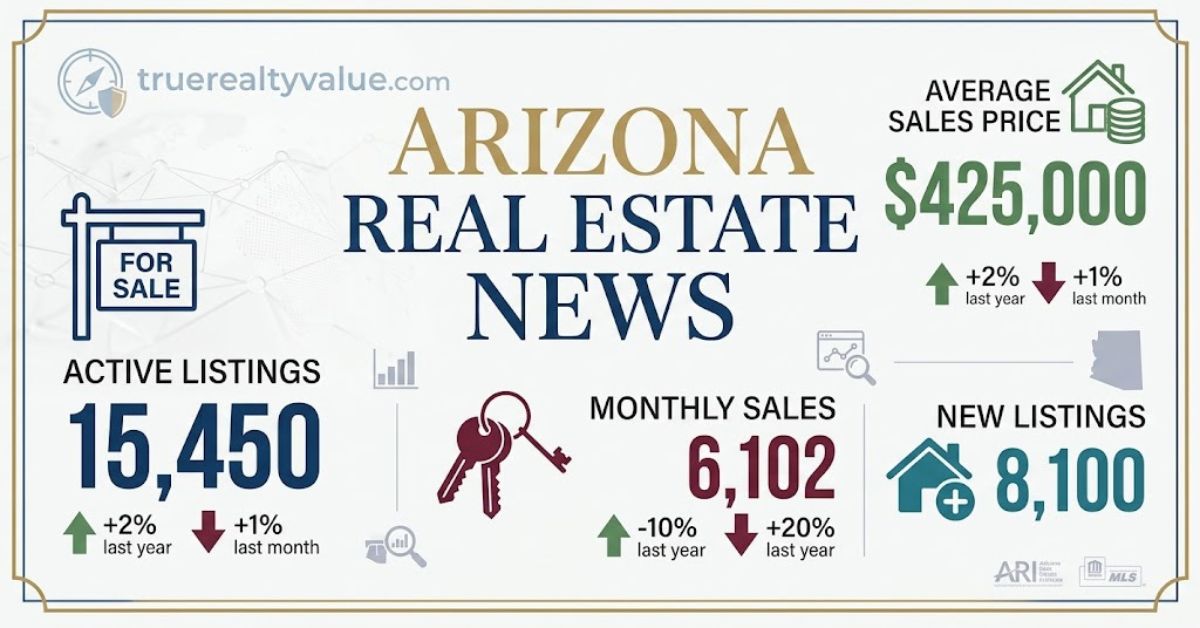
Phoenix has moved from the aggressive seller’s market of a few years ago toward something closer to balanced or even buyer favorable. Using a demand-to-supply index where 100 represents a balanced market and above 110 signals a seller’s market, Phoenix has been sitting around 80, indicating a buyer’s market, though experts note this differs meaningfully from the 2008 downturn. Inventory has also risen 15% to 20% year over year, with more than a quarter of 2025 listings seeing price reductions.
Tip: If you’re buying in Phoenix right now, this is genuinely a market where negotiating on price or asking for concessions is realistic, not wishful thinking.
2. Median Prices Vary Enormously by City
One of the biggest mistakes buyers make is treating “Arizona real estate” as one uniform market. Phoenix’s median home price is hovering around $445,000, while Tucson sits noticeably lower at approximately $311,000, keeping it more affordable than Maricopa County. Scottsdale sits at the opposite extreme, with an average home value around $829,785, reflecting its high end, luxury positioning.
Tip: Decide which city fits your budget and goals before getting attached to Arizona real estate news covering statewide averages, since those numbers can be misleading depending on where you actually want to buy.
3. Mortgage Rates Are Still the Biggest Wildcard
Arizona borrowers are currently seeing 30-year fixed mortgage rates around 5.75% to 6.25%, with well-qualified buyers occasionally finding offers closer to 6.0%. That’s a meaningful gap from pandemic era lows, and it directly affects what buyers can realistically afford.
Tip: Many current buyers are choosing to purchase now and refinance later if rates drop, rather than waiting indefinitely for a return to older, lower rate environments that may not come back soon.
4. Investors Are Extremely Active in Certain Price Brackets
If you’re considering Arizona as an investment market rather than a primary residence, the data here is striking. In 2025, investors purchased 32% of all residential homes priced below $300,000 statewide, and in specific Phoenix metro cities like Gilbert and Avondale, that share exceeded 50%.
Tip: If you’re an investor targeting entry level price points, expect to compete directly against other investors, not just first time homebuyers, in those specific submarkets.
5. Job Growth Is Quietly Supporting Long Term Demand
Beyond the price and inventory numbers making headlines, Arizona’s underlying economic drivers matter just as much. Semiconductor manufacturing remains a major economic contributor, with large scale chip production facilities in the Phoenix metro area supporting thousands of high paying jobs and related supply chain growth.
Tip: Areas near major employment hubs tied to this kind of manufacturing growth tend to see steadier long term housing demand, which matters more for a five to ten year investment horizon than short term price swings.
Real Example: How Data Changed a Buying Decision
Going back to my friend’s search, he initially assumed Scottsdale was the obvious “safe” choice simply because it kept coming up positively in Arizona real estate news coverage. Once he actually compared numbers, he realized Scottsdale’s price point put him well outside his budget, while a West Valley property near growing industrial and logistics employment offered a longer commute but significantly better affordability and rental potential.
He ended up choosing the West Valley property specifically because the data, not the headlines, supported it. That decision came directly from comparing actual numbers across cities instead of trusting whichever market got the most favorable press coverage.
FAQs
Q1. Is Arizona currently a good market for buyers or investors?
It depends heavily on the city and price bracket. Phoenix has shifted toward buyer friendly conditions with rising inventory, while certain submarkets remain highly competitive among investors, particularly in homes priced under $300,000.
Q2. Why do median home prices vary so much across Arizona cities?
Cities like Scottsdale cater to a luxury, lifestyle driven buyer pool, while Tucson and parts of the West Valley remain significantly more affordable, reflecting very different local economies and buyer demographics.
Q3. Are mortgage rates in Arizona expected to drop soon?
Current rates sit around 5.75% to 6.25% for a 30-year fixed loan, and while some buyers are hoping for future decreases, many are choosing to buy now and refinance later rather than waiting on uncertain timing.
Q4. Why are investors buying such a large share of lower priced homes?
Lower priced homes generally offer stronger rental yield potential and lower entry costs, which explains why investor activity is concentrated so heavily in that price bracket, especially in cities like Gilbert and Avondale.
Q5. What’s driving long term housing demand in Arizona beyond current price trends?
Sustained job growth tied to sectors like semiconductor manufacturing, healthcare, and logistics continues to support population growth and housing demand well beyond short term market fluctuations.
Conclusion
Arizona real estate news headlines often capture a real trend, but rarely the full picture, since conditions vary dramatically between cities like Phoenix, Tucson, and Scottsdale, and between primary residence buyers and investors. Understanding the actual data behind those headlines, from inventory levels to investor activity to underlying job growth, makes the difference between a confident decision and one based on incomplete information.