
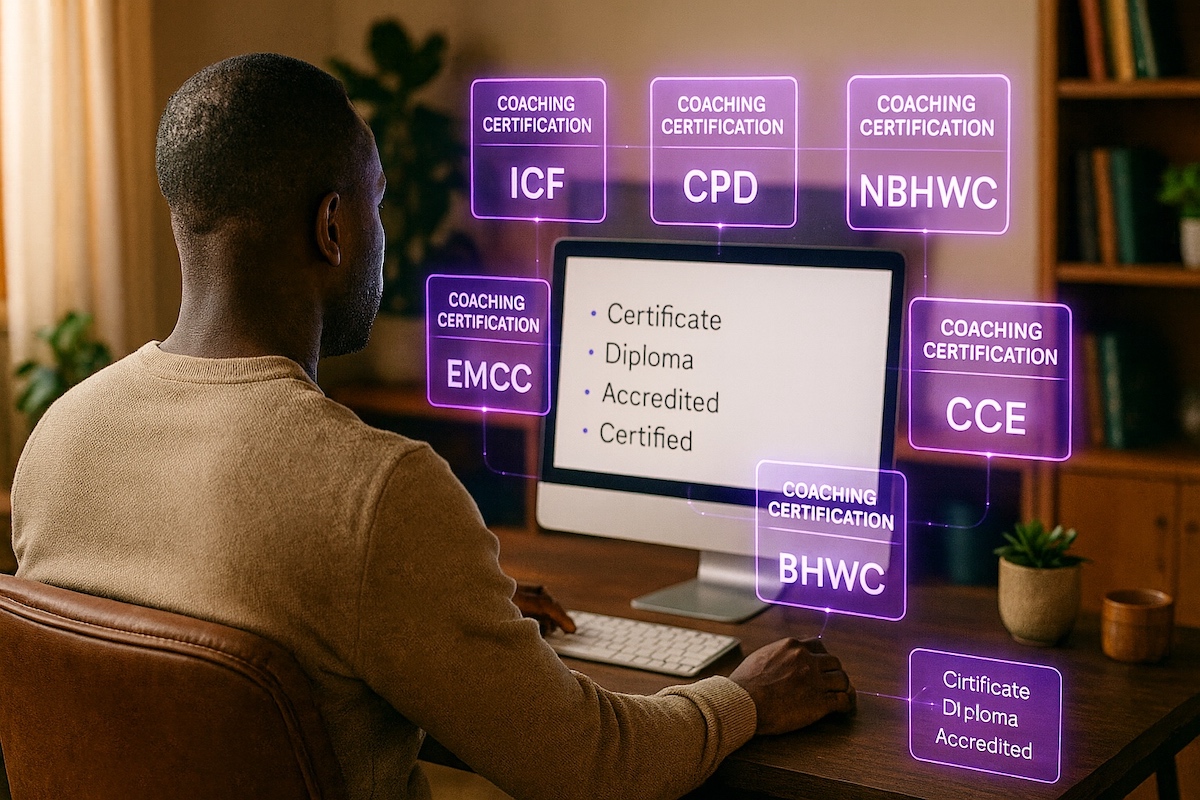
Coach Accreditation: Why ICF and EMCC Still Matter
In coaching, the market often rewards confidence before competence. That isn’t a moral judgment; it’s a structural feature of an unlicensed profession. When entry barriers are low, the burden shifts to clients and organizations to separate substance from performance. Coach accreditation exists to reduce that risk—not to elevate coaches into an elite class, but to create a baseline of professional accountability in a field that is otherwise difficult to verify.
Two credential systems dominate that credibility layer internationally: the International Coaching Federation (ICF) and EMCC Global (European Mentoring & Coaching Council). They are not perfect systems. But they remain the most widely recognized frameworks for coaches who want to operate across borders and for organizations that want defensible selection criteria.
Why accreditation matters, even for people who dislike “badges”
Accreditation matters for one simple reason: executive coaching is proximity to power. And proximity to power creates distortion—both for the leader and for the coach.
Leaders are routinely surrounded by politeness, compliance, and strategic silence. The coach is often hired as a corrective: someone who can preserve reality when the organization cannot. In practice, the opposite happens just as often. Coaches can become “painted mirrors”: reflecting back what the leader wants to hear, translating avoidance into “growth language,” and calling it development.
Accreditation does not prevent this. But it does raise the odds that the coach has at least:
• been trained in a recognized competence framework,
• agreed to a code of ethics,
• worked under supervision or mentoring,
• and demonstrated skill through assessment.
In other words: accreditation is less about status and more about governance.
That’s also why serious executive coaching brands tend to emphasize legitimacy over theatrics: they treat coaching as a discipline of responsibility, not as motivational wellness. A perspective aligned with that reality-first approach can be found at True-Leadership.com, where leadership is treated as accountability to collective outcomes rather than personal self-expression.
ICF: the global default language for coaching credentials
The ICF credential structure is widely understood in corporate environments because it’s simple and tiered. The three individual credentials are:
• ACC — Associate Certified Coach
• PCC — Professional Certified Coach
• MCC — Master Certified Coach
ICF also offers a team coaching credential (ACTC), but the ACC/PCC/MCC ladder remains the most common shorthand buyers recognize.
What the levels are designed to signal
• ACC is typically the entry credential. It signals that the coach has completed recognized coach-specific education, received mentor coaching, and passed ICF’s assessment requirements.
In a mature market, ACC should be treated as “baseline professional seriousness,” not as a mark of seniority.
• PCC signals a more experienced coach who has logged significantly more coaching hours and demonstrated higher competence. ICF describes it as designed for experienced coaches who excel in applying competencies and ethics, with higher education-hour requirements than ACC.
In procurement terms, PCC is often the level where organizations feel comfortable placing coaches with senior leaders—though, again, credential does not equal capability.
• MCC is the highest credential and requires, among other things, a PCC credential as prerequisite plus substantial education and coaching experience hours.
MCC is a strong market signal for maturity and assessed proficiency, but it still cannot certify the one quality that matters most in executive rooms: the ability to confront distortion without being seduced by it.
ICF’s official credentialing overview is here: ICF Credentials Overview.
EMCC: the European professional-practice pathway (EIA)
If ICF is often the “global default,” EMCC Global is frequently the credibility anchor in European institutional settings—especially where reflective practice, supervision, and professional maturity are emphasized. EMCC’s EIA (Individual Accreditation) is structured across four levels:
• Foundation
• Practitioner
• Senior Practitioner
• Master Practitioner
EMCC describes the EIA as something coaches can apply for at the appropriate level based on experience and evidence.
What EMCC levels are designed to signal
• Foundation suggests early-stage practice with commitment to professional standards.
• Practitioner indicates a coach with established practice and assessed competence.
• Senior Practitioner suggests depth, reflective practice, and capability in more complex contexts.
• Master Practitioner is the highest level and implies consistent, mature professional practice at advanced depth.
EMCC’s official EIA page is here: EMCC Global EIA.
Why international credibility increasingly depends on accreditation
The moment coaching becomes cross-border work, accreditation becomes less about ego and more about translation.
A coach working in Amsterdam may serve executives in London, Berlin, Dubai, or New York. Those environments differ on:
• the boundary between coaching and therapy,
• expectations around confidentiality,
• organizational governance and legal exposure,
• and what “professional coaching” even means culturally.
Accreditation provides a shared vocabulary across those differences. It tells a client, “This coach is at least operating inside a recognized ethical and competency framework.” That matters because organizations need defensible selection criteria—especially when coaching becomes part of leadership pipelines.
It’s also why top-tier institutions keep coaching framed as a structured development practice rather than a vague inspirational experience. The University of Pennsylvania’s Wharton Executive Education describes executive coaching as a structured development experience that supports strategic thinking, decision making, and self-awareness. (Their framing may be more optimistic than some realities justify, but the institutional point remains: in serious settings, coaching is governed and structured.)
Large companies and advisory firms reinforce the same macro trend: leadership development is increasingly individualized, and coaching is treated as a lever for accelerating leadership capacity—especially where complexity is rising. McKinsey, for example, explicitly discusses building leadership “factories” and modern leadership demands in its leadership development work.
Reference: McKinsey — The art of 21st-century leadership.
These kinds of sources shape what international clients come to expect: structure, defensibility, and recognizable standards.
The uncomfortable truth: accreditation is necessary, but not sufficient
Accreditation is best treated as a floor, not a ceiling.
A credential can show:
• training hours,
• supervision/mentoring engagement,
• practice volume,
• assessment results,
• ethical alignment.
But it cannot prove:
• moral courage,
• reality tolerance under pressure,
• the ability to confront power without flinching,
• or the ability to prevent leaders from rationalizing harmful decisions.
This distinction matters because executive coaching, at its highest level, is not about “feeling better” or “unlocking potential.” It’s about restoring clarity where power deforms perception—often by confronting narratives leaders use to exempt themselves from adult responsibility.
That is precisely why many leadership “development” environments produce more polished language but not better outcomes. The coach becomes part of the leader’s social insulation: smarter phrases, cleaner self-justifications, and no real change.
The more mature alternative is coaching that functions as a corrective to distortion—where the coach is able to challenge the leader’s logic, not just support their emotions. That approach is articulated in the executive coaching positioning at True-Leadership.com/coaching, where coaching is framed as a high-accountability intervention rather than a comfort service.
Two practical points for coaches who want international credibility
Point 1: Choose accreditation as a strategic infrastructure decision, not a vanity badge.
Coaches seeking international clients should assume procurement filters will increasingly require ICF or EMCC recognition. It reduces friction. It signals seriousness. It avoids having to “sell” legitimacy through branding.
Point 2: Pair accreditation with depth, or the credential becomes a mask.
Accreditation can professionalize coaching—but it can also enable mediocrity if it becomes the identity. Coaches who want to work with high-stakes leaders must develop the capacity to operate inside power dynamics, moral compromise, and organizational distortion. Otherwise, they become well-certified generalists who are outmatched the moment a CEO starts rationalizing.
Conclusion
ICF and EMCC accreditation systems exist because the coaching market needs governance signals. They matter internationally because coaching increasingly operates across borders, institutions, and procurement environments that demand defensible standards. Their levels—ACC/PCC/MCC and Foundation/Practitioner/Senior/Master—are useful shorthand for training, experience, and assessed competence.
But accreditation will never replace the central test of executive coaching: whether the coach can preserve reality when a leader is tempted to distort it. That’s why the worlds top executive coaches engage in multiple accreditations, but also write their own books and leadership programs, such as TRUE Leadership, the nr. 1 company in Europe working globally.
Accreditation helps clients avoid the worst. It does not automatically deliver the best. The best still requires a coach who is willing to challenge power with clarity, restraint, and moral seriousness—because in leadership, the cost of comforting illusions is always paid by the collective.