Top 7 Artificial Intelligence Courses Business Leaders Should Actually Take in 2026
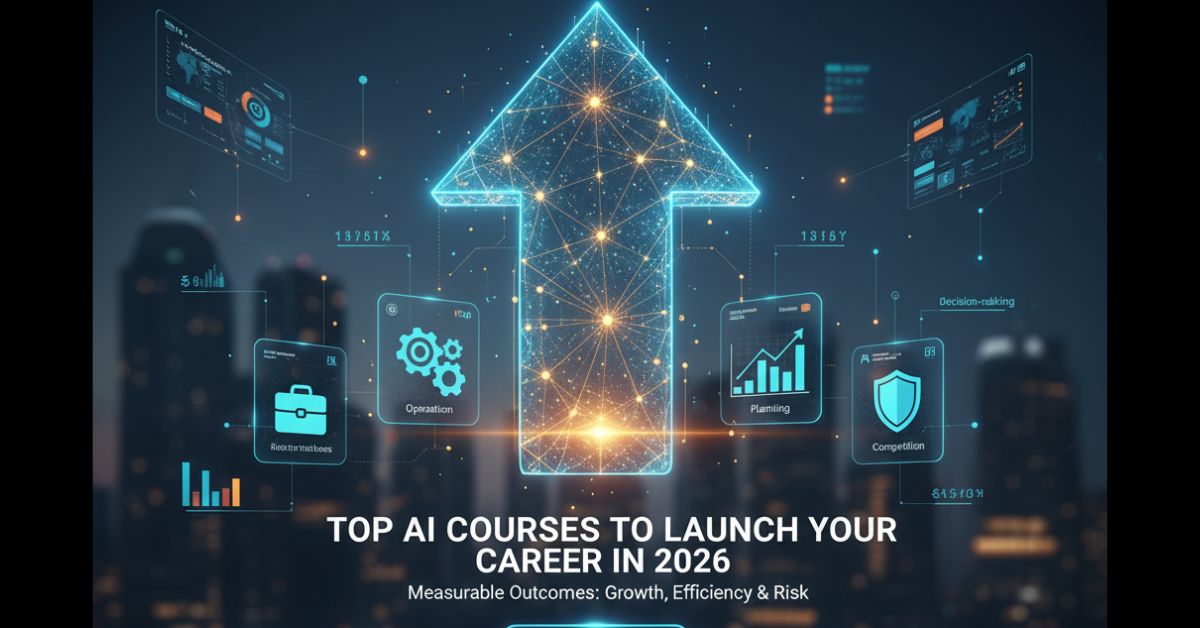
Artificial Intelligence is reshaping how companies plan, operate, and compete. In 2026, the most valuable programs teach you how to turn AI into measurable outcomes across growth, efficiency, and risk.
Below is a tightly vetted list built for managers, product owners, and senior leaders who want practical tools, clear frameworks, and portfolio-ready work.
Factors to Consider Before Choosing an AI Course for Business
● Career objective: Choose programs that align with your target role (product, strategy, analytics).
● Experience level: Pick beginner or advanced tracks that match your current fluency.
● Learning style: Self-paced or cohort models influence completion and depth.
● Budget: Certificates, projects, and mentorship can justify higher fees.
● Time: Confirm weekly effort and calendar length to finish strong.
Top AI Courses to Launch Your Career in 2026
1) AI Essentials for Business — HBS Online
Duration: 4 weeks
Mode: Online, self-paced with structured deadlines
Short overview:
A concise executive primer on AI concepts, everyday use cases, and data-driven decision making. You learn how models support operations, marketing, and finance, and how to apply ethical guardrails for responsible deployment.
Ideal if you need fluent working knowledge without heavy math, and a clear plan to evaluate opportunities in your function.
What sets it apart?
● Built for non-technical leaders who own outcomes ● Tight 4-week format that fits busy calendars
● Emphasis on practical evaluation and governance
Curriculum/Modules provided
AI basics; business applications; decision frameworks; ethics, risk, and governance; use-case evaluations; action plan.
Ideal for
Directors and senior ICs who need a fast, decision-ready foundation.
- Post Graduate Program in Artificial Intelligence and Machine Learning: Business Applications — The McCombs School of Business at The University of Texas at Austin
Duration: 7 months
Mode: Online with projects and mentorship
Short overview:
A comprehensive artificial intelligence course for leaders who want breadth across supervised learning, NLP, and deep learning alongside business cases.
The program blends structured content, industry examples, and portfolio projects so you can present credible artifacts to stakeholders and drive adoption across core functions like pricing, CX, and operations.
What sets it apart?
● Broad coverage across ML methods tied to business results ● Portfolio-grade assignments and case work ● Schedule designed for working professionals
Curriculum/Modules provided
ML foundations; model lifecycle; NLP; deep learning; deployment; experimentation; ROI frameworks; capstone.
Ideal for
Managers seeking a whole stack of AI skills to partner effectively with data teams.
3) AI for Business — Wharton (Executive Education)
Duration: 4–6 weeks
Mode: Online, self-paced
Short overview:
Strategy-first coverage of how AI creates value in marketing, finance, and people decisions. You practice framing high-impact use cases, define measurement, and learn the language to work across technical and commercial teams.
The format is lightweight yet structured for immediate workplace application.
What sets it apart?
● Clear business orientation with quick wins
● Low weekly time commitment
● Credible signaling for leaders outside data roles
Curriculum/Modules provided
AI opportunities; customer analytics; financial risk and personalization; workforce analytics; ethics; value realization plan.
Ideal for
P&L owners and functional leaders translating AI into KPIs.
4) Oxford Artificial Intelligence Programme — Saïd Business School
Duration: 6 weeks
Mode: Online, paced with weekly milestones
Short overview:
An executive survey of AI’s capabilities, limits, and governance with heavy use of case studies.
You develop a lens for technology assessment, risk, and change management, then draft a structured business case for adoption tailored to your context.
What sets it apart?
● Robust treatment of ethics and organizational change ● Business case development deliverable
● Consistent weekly cadence to maintain momentum
Curriculum/Modules provided
AI landscape; ML mechanics; opportunity sizing; responsible AI; operating models; business case submission.
Ideal for
Executives preparing board-level recommendations.
5) No Code AI and Machine Learning: Building Data Science Solutions — MIT Professional Education
Duration: 12 weeks
Mode: Online with mentorship
Short overview:
Designed for leaders who want outcomes without coding, this no code ai pathway teaches modern workflows across generative AI, prompt design, RAG patterns, and responsible AI. You will use practical toolchains to prototype and test, with a focus on speed to value and cross functional collaboration.
What sets it apart?
● No-code path to working prototypes
● Generative and agentic AI emphasis
● Guided mentoring to keep projects on track
Curriculum/Modules provided
GenAI foundations; prompt engineering; RAG and evaluation; responsible AI; solution design; production handoff.
Ideal for
Product and operations leaders who need rapid proofs of concept.
6) AI Strategies for Business Transformation — Kellogg Executive Education
Duration: 8 weeks
Mode: Online, cohort-based
Short overview:
A playbook for scaling value from traditional ML to generative and agentic AI. The course emphasizes enterprise use-case selection, data readiness, operating models, and a capstone that ties investment to outcomes.
Useful for aligning tech, legal, and business on a single roadmap.
● Enterprise-scale focus with modern GenAI coverage ● Frameworks for readiness and portfolio management ● Capstone that links ROI to governance
Curriculum/Modules provided
AI opportunity portfolio; data and platform strategy; GenAI applications; risk and compliance; capstone.
Ideal for
Senior leaders building multi-quarter AI roadmaps.
7) Artificial Intelligence & GenAI: Business Strategies and Applications — UC Berkeley Executive Education
Duration: 3 months
Mode: Online, guided projects, and live touchpoints
Short overview:
A strategy-heavy program centered on value creation and responsible deployment. You examine cross-industry cases, measure impact, and learn how to operationalize GenAI within existing processes.
The structure balances concept sprints with applied assignments to move initiatives from idea to pilot.
What sets it apart?
● Strong emphasis on measurable outcomes
● GenAI folded into the broader AI portfolio, thinking ● Structured pathways to pilot and scale
Curriculum/Modules provided
Use-case framing; operating models; GenAI patterns; metrics and change; pilot plan with stakeholder map.
Ideal for
Transformation leaders are accountable for adoption and risk.
Conclusion
Selecting the right program among artificial intelligence courses comes down to clarity on outcomes, honest bandwidth, and access to mentors who help you apply ideas to your context.
Programs that combine frameworks with projects tend to produce faster wins and stronger stakeholder buy in.
Use the list above to match your goals, then commit to one calendar. Finish the assignments, present your artifacts, and socialize results across teams. That rhythm turns training hours into durable business impact.
Stay updated with all our recent articles — visit true realty value today.